Django Miceli
12/5/24
The Waterseller of Seville
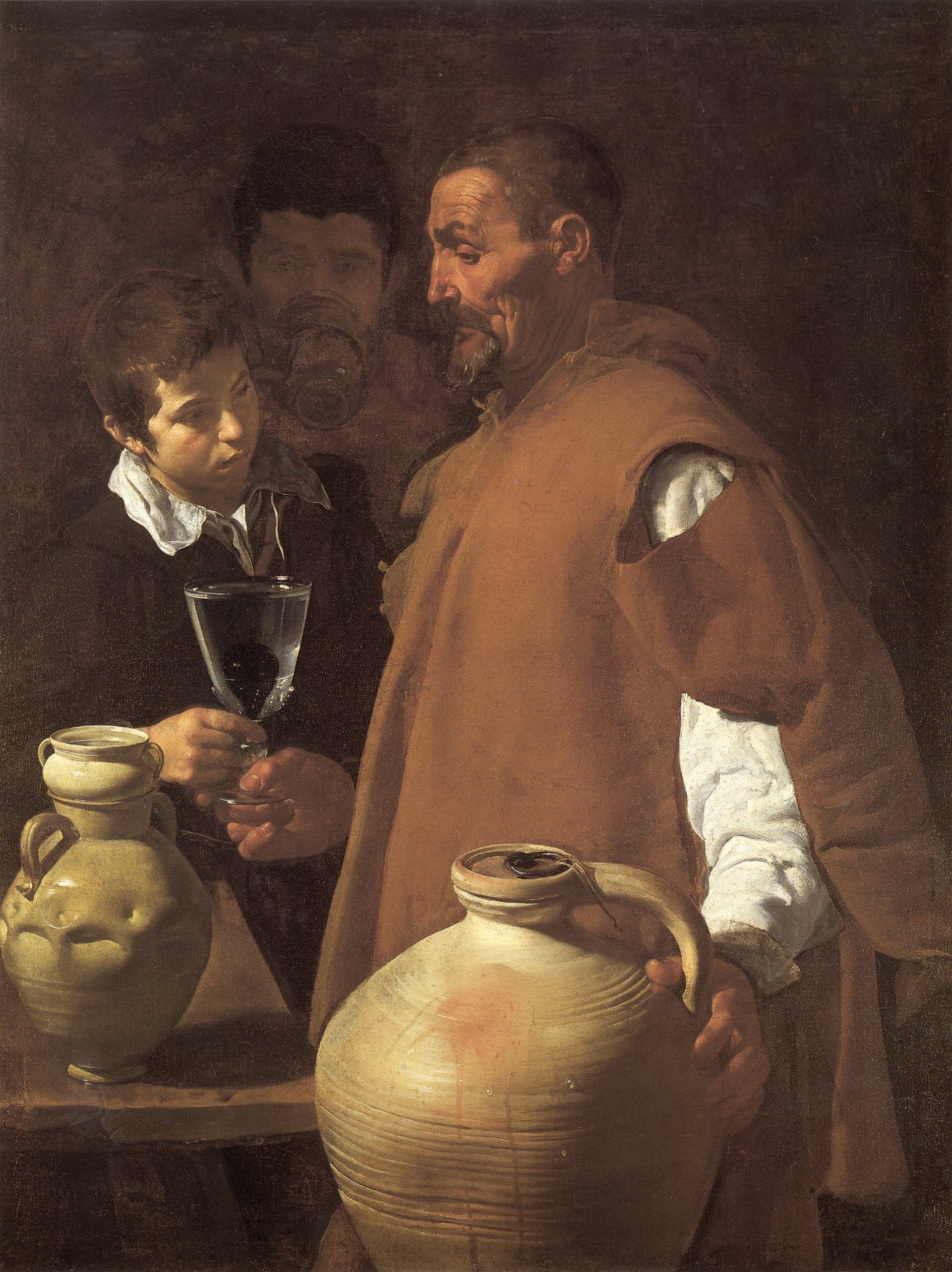
Velázquez’s painting, The Waterseller of Seville, has left audiences questioning its meanings to this day. Velázquez painted The Waterseller in 1618-1622. The painting was owned by Juan de Fonseca y Figueroa in 1622-1623. Fonseca brought this work to King Philip IV and secured Velázquez's position as court painter, where he became the first court painter to be paid. Lopez-Ray writes that after Fonseca died in 1627, Velázquez valued all of the paintings in his collection and appraised The Waterseller as the highest of all. It offers a glimpse into a 17th-century scene in Seville in a dimly lit tavern.
According to Tanya Tiffany, the painting was most likely a gift for Don Juan de Fonseca y Figuera, the royal chaplain to Philip IV. It is possible that the painting was conceived with Fonseca’s interests in mind. This is because both Fonseca and Velázquez are from Seville and were familiar with the issues of poverty. This type of Spanish painting genre, known as Bodegónes, was a growing style representing humble subjects, like a water seller or a woman cooking. Bodegónes translates to tavern and depiction of everyday life, hence the location of these works, but they did not have to take place in a tavern. Tanya Tiffany finds that the figures here are all related to each other through their poses rather than their expressions. This brings a drowsiness to the senses, and the stillness and earthy tones amplify this. Some argue that it is an idealized depiction of a water seller, but I don’t think that was Velázquez's intention. He is bringing light to the rarely represented underclass through first-hand observation.
Velázquez, The Waterseller of Seville, 1618-22.
Francisco Pacheco was Velázquez's teacher, and his theoretical arguments about the subject matter are directly pushed back in The Waterseller of Seville, as he would not teach the painting of humble subjects. Lopez-Rey finds that no convincing literary counterpart has been discovered for the painting. It's not related to a prior source or scene of everyday life, so as far as we know, it’s a complete original.
The composition of the painting is arranged to draw the viewer's attention to the central figure, the water seller. He stands in the foreground, dominating the composition. The water jugs in his hands are detailed with water droplets. Velázquez masterfully uses strong contrasts between light and shadow to create a dimly lit scene. The light falling on the water seller's face and body highlights his tattered garments. The expression on his face shows how he is distant from the situation at hand. All three men are avoiding any unnecessary interaction. The waterseller and the boy hold the glass. Within there is a fig which, during this time, was commonly used for the added flavoring to water. According to Lopez-Rey, “The variety of fig used for this purpose due to its great sweetness is that known as zafari or zahari.”
The arrangement of three distinct planes highlights the realistic depth of the foreground, featuring a large clay jar, a pitcher set on a table, and a glass held by two hands—all perfectly aligned in perspective. “Velázquez’s exceptional ability to depict textures shines through in the details: the rough surface of the jar with droplets of water, the glossy finish of the pitcher, and the transparent glass reflecting light, water, and a decorative purple fig. The earth tones used throughout the image and for each pot are expected for bodegónes.”
After Fonseca’s ownership (1622-23), the painting became the property of the king’s brother, Cardinal-Infante. During the Napoleonic wars in 1803, Joseph Bonaparte stole the painting. In 1813, the Duke of Wellington won back the painting during the Battle of Vittoria. Today, the painting is located in the Wellington Collection of Apsley House in London, England.
According to Antonio Palomino, the famous waterseller El Corzo may be related to the painting. “It was recorded in the royal inventory of the Buen Retiro Palace drawn up in 1701, and memories of his physical appearance seem to have been still alive at the time when Palomino wrote his life of Velázquez, first published in 1724.” Palomino’s description – in which he mentions only two of the three figures in the composition – reads as follows (pp. 892-3): “The painting called the Waterseller, who is an old man very shabbily dressed in a sordid and ragged smock, which would reveal his chest and abdomen covered with scabs and hard, strong calluses. And beside him, there is a boy, to whom he is giving a drink. This work has been so talked of that it has been kept to this day at the Palace of the Buen Retiro”.
Velázquez's keen observation of society is evident in his genre paintings, such as The Waterseller of Seville. These scenes of everyday life provide glimpses into the socio-economic realities of 17th-century Spain. “By depicting common people engaged in daily activities, Velázquez brings the social fabric to life, offering a window into the diversity and vibrancy of Spanish society. His choice to immortalize the ordinary reflects a democratization of art, challenging the elitist norms prevalent in the contemporary artistic landscape. He was going against everything he was taught while making the bodegónes.” The same boy from The Waterseller of Seville is seen in An Old Woman Frying Eggs, another composition by Velázquez, done before The Waterseller. This could be because Velázquez had a reference to a young boy whom he was fond of. The boy fits each scene well, looking like he belongs there.
Velásquez’s The Waterseller of Seville displays lower-class poverty. The man selling his water is doing a dutiful job. Bodegones were for depicting such. David Davies finds that these paintings were not for the working class to buy because they were highly priced. The Waterseller is valued the most and it is widely considered Velázquez's first masterpiece.
There are two other known images of The Waterseller. They are said to be executed in a rather dry manner in Lopez-Rey’s catalogue raisonné. The Waterseller figure wears a cap in both of them. One is more of a copy of the initial replica than it is of the original painting itself, and was executed in a much looser and weaker style. These pieces are most likely not by Velázquez himself. However, one can't be certain of their origins.
Some say that this work can represent the three stages of man and link it to Titian's late work, The Three Stages of Man, 1512. However, the figures are captured with quiet dignity reflecting Velázquez's empathy for his subjects, giving the humble waterseller and his customers quite the opposite effect of a generalization of age. Through this piece, Velázquez elevates the everyday labor of common people to a level of reverence and artistry, challenging the social norms of his time by assigning worth and beauty to scenes that might have otherwise been dismissed as mundane. This humanizing approach not only reveals Velázquez's talent but also his intention to capture the subtle grace and dignity of ordinary life.
Velázquez, Old Woman Frying Eggs, 1618.
Thorough Provenance
Owned by Don Juan Fonseca y Figueroa
Bought by Don Gaspar de Bracamonte, from whom it passed into the possession of Cardinal Infante Don Fernando, brother of the king.
Madrid: Juan Fonseca y Figueroa, early admirer and protector of Velázquez (died 1627)
Madrid: Gaspar de Bracamonte.
Madrid: Cardinal Infante Don Fernando.
Madrid: Palacio Real del Buen Retiro (inventory of 1701: ‘El Corzo, aguador’).
Madrid: New Palacio Real (by 1754; inventories of 1772 and 1794).
Carried off by Joseph Bonaparte and taken from him by the Duke of Wellington at the Battle of Vittoria in 1813. It was subsequently presented to the Duke by Ferdinand VII of Spain.
London: Apsley House, Duke of Wellington.
London: Apsley House, the Wellington Museum, no. 1600.
Bibliography
Diego Velázquez’s Early Paintings and the Culture of Seventeenth-Century Seville, Tanya J. Tiffany, 2012.
Lopez-Rey, “Velázquez: A Catalogue Raisonné of his Oeuvre”. 1963.
Fernando Checa, “Velázquez: The Complete Paintings”. 2008.
Velazquez Re-Examined: Theory, History, Poetry, and Theater, Giles Knox & Tanya J. Tiffany. 2017.
Lives of Velázquez, Antonio Palomino. 1724.
David Davies, “Velázquez in Seville”. 1996.